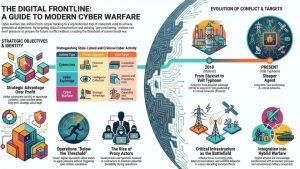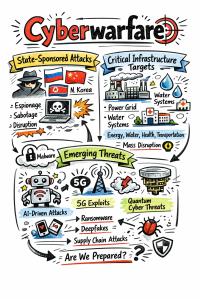


In March 2026, Greek firms in shipping, transport, banking, telecommunications, health, and energy were reported to be scanning their networks as the Iran war raised cyberattack risks. That detail matters because it showed something broader than isolated sector anxiety. Multiple industries in the same economy were reacting at once because they understood that cyberwarfare pressure often lands on connected clusters, not just on one obvious target.
This is a recurring pattern in modern cyber conflict. When sectors share infrastructure, timing dependencies, commercial links, service providers, and regional exposure, attackers do not need to pick them off one by one to generate pressure. The risk spreads across the cluster because disruption in one part can quickly affect the others.
That is why the March 2026 Greek case deserves more than a simple “heightened alert” reading. It shows how cyberwarfare can push entire industry groupings into defensive posture at the same time. The issue is not only which single company is most likely to be hit. It is which cluster of interdependent sectors can be made to feel pressure together.
Why industry clusters absorb cyberwarfare pressure together
Industry clusters absorb pressure together because connected sectors rarely operate in isolation. Shipping depends on finance, finance depends on telecommunications, healthcare depends on energy and transport, and all of them rely on shared service providers, identity layers, and digital coordination. When conflict raises cyber risk, those interdependencies turn separate industries into a single operational surface.
That means pressure can spread even before a confirmed major incident occurs. Firms in one sector harden because they know disruption in an adjacent sector can quickly become their problem too. In practice, cyberwarfare often exploits the fact that clustered industries share timing, infrastructure, and exposure more than they share formal organizational boundaries.
This is one reason the March 2026 Greek alert cycle mattered. It was not just one sector reacting to one threat. It was a regional cluster of strategically connected industries recognizing that if cyber pressure landed anywhere in that chain, the effects could travel across the rest.
What makes industry clusters strategically useful in cyberwarfare
Industry clusters are strategically useful because pressure in one part of the cluster can impose cost across the rest. If cyber risk rises around a port network, a banking channel, a telecom provider, or an energy supplier, the downstream effect is not confined to that one organization. It can disrupt planning, increase uncertainty, slow transactions, and force multiple sectors into a more defensive posture at the same time.
There is also an efficiency advantage for attackers. They do not need to compromise every company inside a regional economy to create broad pressure. By focusing on a tightly connected cluster of sectors, they can generate spillover, caution, and operational friction more efficiently than by pursuing isolated targets with no meaningful dependency between them.
We have already seen the broader context for this in our article on shipping and logistics networks as pressure points, in our article on banking and financial pressure points, and in our article on communications networks under cyberwarfare pressure. The Greek case showed why these sectors often matter most when they are read together rather than separately.
What defenders should prioritize when clusters come under pressure
For defenders, the priority is not only protecting their own organization in isolation. It is mapping the shared dependencies that connect clustered sectors: telecom links, financial rails, transport timing, supplier access, energy continuity, identity systems, and third-party platforms. Those are the paths through which pressure can move fastest.
It also helps to think beyond firm-by-firm response. When multiple industries in the same regional cluster face the same conflict-driven cyber risk, resilience becomes a coordination problem as much as a technical one. Information sharing, contingency planning, and fallback operations need to reflect the fact that one sector’s disruption can quickly become another sector’s operational problem.
The broader lesson is simple: in cyberwarfare, the real target is often not a single company but a connected industrial cluster. That is why defenders need to understand how pressure can move across sectors, not just how it can land inside one network.
Cyberwarfare often pressures connected industries together
The March 2026 alerting across Greek sectors reinforced a useful reality: cyberwarfare pressure often lands on industry clusters rather than isolated firms. When shipping, finance, telecom, health, energy, and transport are tightly connected, stress in one part of the cluster can quickly shape the rest.
That is why this pattern matters. It shows that cyberwarfare can impose caution, cost, and operational friction across an interconnected industrial grouping without requiring a direct hit on every company inside it. For defenders, the lesson is to treat clustered dependencies as part of the conflict surface, not just as background business context.