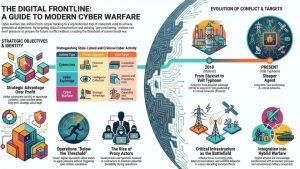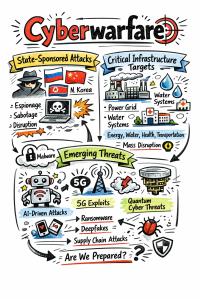

Cyberwarfare becomes easier to understand when you stop thinking only in terms of malware and start thinking in terms of sectors. Nation states do not target infrastructure at random. They look for systems that support public order, essential services, economic continuity, military readiness, and crisis response. The more a sector shapes daily life or national resilience, the more valuable it can become in strategic cyber competition.
That does not mean every critical infrastructure sector is equally exposed in the same way. Some sectors are attractive because they can create visible public disruption. Others matter because they enable almost everything else to function. Some are targeted for pre-positioning and crisis leverage, while others are more likely to be used for signaling, intelligence preparation, or cascading pressure during geopolitical tension.
This guide explains the 10 critical infrastructure sectors most exposed in cyberwarfare. The goal is to help readers understand which sectors matter most, why attackers care about them, and how their disruption could create wider strategic consequences beyond a single technical incident.
Top 10 critical infrastructure sectors most exposed in cyberwarfare
Some sectors matter more in cyberwarfare because disrupting them creates immediate public effects, while others matter because they enable many other sectors to function. These are the sectors most likely to attract attention in strategic cyber competition.
1. Energy
Energy systems remain among the most exposed sectors because power generation, transmission, fuel distribution, and grid operations sit at the center of national resilience. Disruption can affect homes, industry, healthcare, communications, transport, and military readiness all at once. Even limited outages can create public anxiety and operational paralysis.
This is why energy is often treated as a core cyberwarfare target. It combines symbolic value, cascading impact, and direct pressure on daily life.
2. Communications and telecommunications
Communications infrastructure is essential for government coordination, emergency response, military command, civilian trust, and economic continuity. If communications degrade, many other sectors struggle to coordinate effectively even when they remain technically functional.
Telecommunications systems are also useful for espionage, signaling, and disruption, which makes them relevant across multiple stages of state cyber competition.
3. Transportation and logistics
Transport networks matter because they move people, fuel, food, equipment, and military resources. Ports, rail systems, aviation support, shipping platforms, and freight coordination can all become strategically valuable in a crisis. Even a modest cyber incident in logistics can create wide secondary effects.
In cyberwarfare terms, logistics disruption is attractive because it slows everything else without always requiring dramatic destructive action.
4. Water and wastewater
Water systems are highly sensitive because they directly affect public health and social stability. They are also often distributed, operationally constrained, and dependent on industrial control environments that may be harder to modernize than mainstream IT systems.
The strategic value here is not just immediate disruption. It is the pressure created when a basic life-sustaining service becomes uncertain or untrusted.
5. Healthcare and public health infrastructure
Healthcare matters in cyberwarfare because disruption can generate fear, loss of trust, medical delay, and human cost very quickly. Hospitals, care networks, diagnostics, emergency coordination, and pharmaceutical support chains all sit close to the public and are difficult to pause safely.
Attackers do not need large-scale destruction to create serious effect here. Even degraded availability or coordination can generate disproportionate consequences.
6. Government administration and public services
Government systems support identity, benefits, records, public communication, licensing, taxation, and crisis coordination. If those systems become unreliable, the state can appear weaker, slower, or less credible under pressure. That makes government administration relevant even when the immediate damage is mostly institutional rather than physical.
This sector also has symbolic value. Visible disruption to public services can be used to undermine confidence in governance itself.
7. Financial services and payment infrastructure
Financial systems matter because confidence and continuity are central to economic stability. Payment rails, clearing systems, banking operations, and high-trust financial infrastructure can all become leverage points in strategic cyber competition. Attackers do not necessarily need to steal money to create instability. They only need to interrupt trust.
That makes finance an attractive sector for signaling, pressure, and uncertainty during periods of geopolitical tension.
8. Industrial control systems and manufacturing
Manufacturing and industrial control environments matter because they support supply chains, defense production, critical goods, and essential economic activity. These environments can also be technically fragile, operationally sensitive, and difficult to patch without downtime.
Readers should connect this directly to Stuxnet: The Cyber Weapon That Changed Warfare, which remains one of the clearest examples of why industrial environments occupy such an important place in cyberwarfare thinking.
9. Identity, authentication, and access infrastructure
Identity systems are not always named as a separate sector, but in practice they are some of the most strategically important infrastructure components in modern cyber conflict. When identity platforms fail or are compromised, many other sectors become easier to reach, harder to trust, and slower to recover.
This is one reason state-linked operators often care about credentials, remote administration, and trusted access paths as much as the final target itself. Identity is the control layer behind much of modern infrastructure.
10. Supply chain and service-provider ecosystems
Supply chain platforms, managed service providers, software distribution channels, and cross-sector service dependencies are highly exposed because they let one compromise travel farther than a direct attack on a single target. In cyberwarfare, that makes them valuable for scale, ambiguity, and leverage.
The strategic lesson is simple: the most exposed sectors are not always the ones with the most dramatic headlines. They are the ones whose disruption can spread, compound, or weaken many other systems at the same time. Readers should also connect this article to What Is Cyber Warfare? Definition, Doctrine, and Real-World Examples, Top 10 Signs a Cyber Campaign Is Pre-Positioning for Future Conflict, and Top 10 Below-Threshold Cyber Operations States Use for the wider strategic context.
How to read sector exposure without assuming every sector faces the same threat
Sector exposure in cyberwarfare is not just about how often a system gets attacked. It is about what happens if the system is degraded, who depends on it, how quickly disruption spreads, and whether the target creates leverage beyond the immediate technical incident. Some sectors matter because they are visible to the public. Others matter because they quietly support everything else.
That is why this article works best as part of the wider Cyberwarzone cyberwarfare cluster. Readers who want the broader context should also review What Is Cyber Warfare? Definition, Doctrine, and Real-World Examples, Top 10 Signs a Cyber Campaign Is Pre-Positioning for Future Conflict, Top 10 Below-Threshold Cyber Operations States Use, Top 10 Differences Between Cyberwarfare and Cyber Espionage, and Stuxnet: The Cyber Weapon That Changed Warfare.
The practical rule is simple: the most exposed sectors are the ones whose disruption creates outsized strategic consequences. That is where cyberwarfare becomes more than a technical security problem and starts to look like a national resilience problem.