
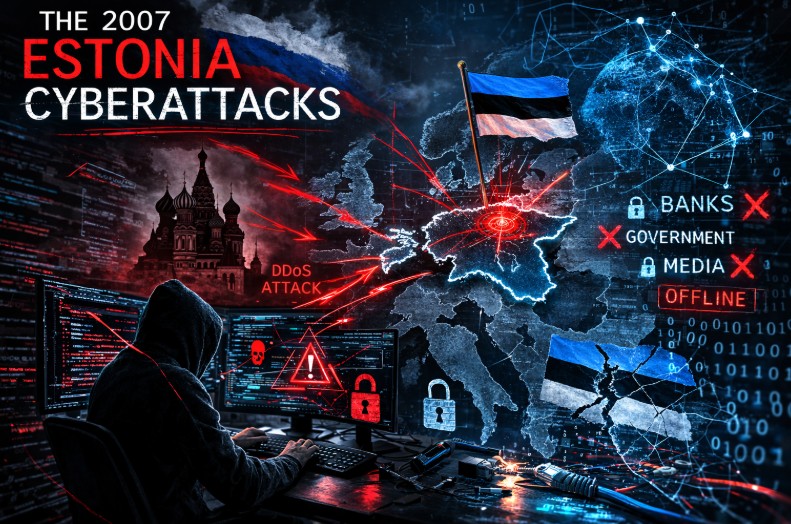

In the spring of 2007, Estonia became the first country to experience a large-scale cyberattack campaign targeting an entire nation’s digital infrastructure. For several weeks, government ministries, banks, media organizations, and telecommunications providers were overwhelmed by distributed denial-of-service (DDoS) attacks that disrupted online services across the country.
The attacks occurred during a political dispute with Russia and demonstrated how digital infrastructure could be used as a battlefield during geopolitical conflict. While the technical methods used in the campaign were relatively simple compared to modern cyber weapons, the strategic implications were profound.
The incident forced governments, military planners, and security professionals to confront the reality that cyber operations could affect national stability. Today, the Estonia attacks are widely studied as an early case study of cyber warfare and remain a reference point in discussions about digital conflict and infrastructure resilience.
Nearly two decades later, the lessons from Estonia continue to shape how governments approach cyber defense, critical infrastructure protection, and national security planning in the digital age.
For readers who want the broader strategic context, see our guide to cyber warfare, its doctrine, and its role in modern geopolitical conflict.
Estonia Before the Attacks: Why a Digital Pioneer Became a Strategic Target
By 2007, Estonia had already built a reputation as one of the most digitally advanced societies in Europe. Following independence in 1991, the country invested heavily in e-government, online public services, and digital identity systems. Estonian citizens could file taxes online, access state services through digital platforms, and rely on internet-based banking for routine financial activity.
This digital-first model created efficiency, but it also increased national dependence on networked infrastructure. Government administration, financial services, media distribution, and public communications were all becoming more tightly connected to internet availability. That dependence mattered. In a less connected country, denial-of-service attacks might have caused inconvenience. In Estonia, they threatened the functioning of state institutions and daily civic life.
The country’s digital architecture was also symbolically important. Estonia was widely presented as a model of post-Soviet modernization and technological progress. That meant any large-scale disruption of its online services would carry both operational and political significance. A successful cyber campaign would not only interrupt services. It would also undermine confidence in the resilience of a modern digital state.
This is one reason the 2007 case remains so important in cyber conflict analysis. The attacks did not target an isolated company or a single ministry. They targeted a country whose governance model was increasingly inseparable from digital connectivity. In that sense, Estonia became an early example of how national digital transformation can expand both capability and exposure at the same time.
For defenders in 2026, that lesson remains highly relevant. The more governments integrate identity systems, public platforms, communications networks, and financial services into unified digital ecosystems, the more those systems become attractive targets during geopolitical crises.
The Bronze Soldier Crisis and the Start of the Cyberattack Campaign
The cyberattacks against Estonia began during a period of intense political tension in April 2007. The immediate trigger was the Estonian government’s decision to relocate the Bronze Soldier of Tallinn, a Soviet-era World War II memorial that had long been a symbol of historical and political dispute between Estonia and Russia.
For many ethnic Estonians, the monument represented decades of Soviet occupation following World War II. For many Russian-speaking residents and political figures in Russia, it symbolized the Soviet Union’s role in defeating Nazi Germany. When the Estonian government announced that the statue would be moved from central Tallinn to a military cemetery, the decision quickly escalated into a diplomatic and social crisis.
Protests broke out in Tallinn, and the issue became a flashpoint in Russian media and political discourse. At the same time that demonstrations were occurring on the streets, a parallel confrontation began unfolding in cyberspace. On 27 April 2007, Estonian government websites began experiencing the first waves of distributed denial-of-service (DDoS) attacks.
What initially appeared to be isolated disruptions soon evolved into a sustained campaign targeting key elements of Estonia’s digital infrastructure. Government ministries, parliament, political parties, banks, news outlets, and telecommunications providers all became targets of repeated attack waves.
The timing of the attacks suggested a strong connection between the political crisis and the cyber campaign. As diplomatic tensions intensified, so did the scale and coordination of the digital disruptions. For security analysts, the Estonia case would later become an early example of how geopolitical conflict can extend into cyberspace even when traditional military forces are not involved.
Key Political Figures Behind the Crisis
The political leadership around the crisis deserves to be named more explicitly. Estonia’s president at the time was Toomas Hendrik Ilves, who had taken office in 2006 and was closely associated with Estonia’s digital-state identity. Ilves was not merely a background figure. He had long been linked to the country’s technology-forward direction and later became one of the most visible European voices arguing that cyber attacks had to be treated as a strategic security issue rather than as a narrow technical problem.
Prime Minister Andrus Ansip and other Estonian officials were responsible for the decision to proceed with the relocation amid mounting tensions. On the Russian side, President Vladimir Putin did not name Estonia directly in his Victory Day speech on 9 May 2007, but he said that those who desecrate monuments to war heroes were sowing discord and distrust between states and peoples. That rhetoric mattered because it showed how quickly the memorial dispute had escalated into a broader confrontation over history, legitimacy, and geopolitical influence.
Adding these figures strengthens the article because the Estonia case was never only a story about packets and botnets. It was also a story about political leadership, symbolic confrontation, and how public rhetoric can shape the atmosphere in which cyber operations unfold.
How the 2007 Cyberattack Campaign Worked
The cyber operations against Estonia relied primarily on distributed denial-of-service (DDoS) attacks. In these attacks, large numbers of computers send massive volumes of requests to targeted servers, overwhelming their ability to respond to legitimate users. When successful, this type of traffic flood can render websites, online services, or communication platforms temporarily inaccessible.
Investigations conducted after the incident revealed that the attack waves were conducted using a combination of techniques. Some early waves involved individuals manually participating in traffic floods by using simple scripts or tools shared in online forums. Later stages of the campaign relied more heavily on botnets consisting of compromised computers distributed across multiple countries.
The attackers targeted a broad range of services that were essential to Estonia’s digital society. Government ministries, the Estonian parliament, political party websites, news organizations, and financial institutions all experienced repeated disruptions. Several major banks temporarily limited online services in order to maintain operational stability while defending against the traffic floods.
The attack traffic often arrived in coordinated bursts designed to overwhelm network capacity. In some cases, attackers attempted to disrupt domain name system (DNS) infrastructure and other key services that supported large segments of Estonia’s internet connectivity. Because many public services relied heavily on online platforms, the effects of these disruptions were widely felt across the country.
Although the tools used during the attacks were not highly sophisticated compared to modern cyber weapons, the scale and coordination of the campaign demonstrated how network-level disruption could be used as a strategic pressure tactic during a political crisis.
How Estonia Responded During the Crisis
Estonia’s response to the attacks required rapid coordination between government agencies, banks, internet service providers, and incident responders. At the center of that effort was CERT-EE, which worked with both domestic and foreign partners to trace malicious traffic, identify attack patterns, and reduce the pressure on critical services.
Mitigation focused on practical network defense measures. Estonian operators filtered malicious traffic, rate-limited requests, hardened externally exposed services, and in some cases temporarily blocked traffic from foreign networks that were generating large volumes of hostile requests. Banks and media organizations also implemented emergency restrictions to preserve core operations while the attacks were ongoing.
The response highlighted an important reality about national cyber defense: most of the systems a government depends on are not operated by the state alone. Financial institutions, telecommunications companies, hosting providers, and media networks all played a role in Estonia’s resilience. The incident therefore became an early demonstration of why cyber defense requires a public-private operating model rather than a purely governmental one.
Estonia was ultimately able to restore and stabilize most affected services without any lasting systemic collapse. Even so, the crisis exposed clear weaknesses in national preparedness, cross-border mitigation, and dependency mapping. Those lessons would directly influence the country’s later cyber strategy and institutional reforms.
For defenders, this section of the Estonia case matters as much as the attack itself. The incident showed that resilience depends not only on preventing intrusion or disruption, but also on the speed of coordination, the ability to segment services, and the capacity to sustain essential public functions under digital pressure.
Attribution, Proxy Actors, and the Gray-Zone Problem
One reason the Estonia case remains analytically important is that attribution was politically significant but technically inconclusive. Estonian officials and many outside observers viewed the timing of the attacks through the lens of the broader political confrontation with Russia. The cyber campaign began immediately after the Bronze Soldier relocation crisis escalated, and the targets aligned with institutions central to Estonian statehood and public communications.
At the same time, proving direct state responsibility was far more difficult. Attack traffic originated from distributed systems across multiple countries, and many of those systems were likely compromised machines operating as part of botnets. Some activity appeared to involve politically motivated individuals and loosely organized online communities rather than a single clearly identifiable command structure.
This ambiguity became one of the defining lessons of the incident. In cyberspace, states do not always need to deploy formally acknowledged government units in order to generate strategic effects. They may benefit from patriotic hackers, informal proxy ecosystems, aligned activist networks, or deniable operators whose actions serve a broader national interest without clear public ownership.
The Estonia attacks therefore helped shape an enduring concept in cyber conflict analysis: the gray zone between peace and war. The campaign did not resemble a traditional armed attack, yet it imposed pressure on a sovereign state during a politically charged confrontation. It also exposed how cyber operations can be used below the threshold of open military conflict while still creating strategic effect.
That lesson remains highly relevant in 2026. Modern cyber campaigns linked to state competition often combine ambiguous attribution, deniable infrastructure, and pressure tactics designed to avoid triggering immediate military escalation. Estonia was one of the first major cases to show how effective that model could be.
How the Estonia Attacks Reshaped NATO Cyber Defense
The 2007 attacks had consequences far beyond Estonia itself. For NATO and many Western governments, the incident demonstrated that cyber operations could affect national stability without the use of conventional military force. The attacks disrupted communications, financial services, and government operations during a politically sensitive moment, forcing policymakers to reconsider how digital infrastructure should be protected during geopolitical crises.
At the time, cyber defense was still a relatively new concept within many defense institutions. Estonia’s experience highlighted the need for coordinated international responses to cyber incidents that could affect multiple countries simultaneously. Internet traffic involved in the attacks originated from systems located around the world, demonstrating that national borders offered little protection against large-scale digital disruption.
One of the most important outcomes of the crisis was the creation of the NATO Cooperative Cyber Defence Centre of Excellence (CCDCOE) in Tallinn in 2008. The center was established to advance research, training, and operational understanding related to cyber conflict and digital defense.
Since its founding, the CCDCOE has become one of the most influential international institutions studying cyber warfare and cyber defense strategy. It organizes multinational exercises, conducts technical and legal research, and supports NATO members in developing cyber defense capabilities.
The establishment of the center symbolized a broader shift in how governments viewed cyberspace. Rather than treating cyber incidents as isolated technical problems, policymakers increasingly recognized digital infrastructure as a strategic domain that could influence national security and military planning.
Estonia’s Transformation Into a Cybersecurity Powerhouse
The events of 2007 triggered a long-term transformation in Estonia’s national cybersecurity strategy. Rather than treating the attacks as an isolated incident, Estonian policymakers concluded that cyber resilience had to become a permanent component of national defense planning.
One of the first steps was the development of a comprehensive national cybersecurity strategy. Estonia began integrating cyber defense planning into broader national security frameworks, recognizing that digital infrastructure could become a primary target during geopolitical tensions. Government agencies responsible for digital governance, telecommunications, and defense were tasked with improving monitoring, incident response coordination, and infrastructure protection.
Estonia also created one of the world’s first volunteer cyber defense organizations. The Cyber Defence Unit within the Estonian Defence League brings together security professionals from the private sector who can support national response efforts during cyber crises. This approach reflects the reality that many of the most experienced cybersecurity specialists work outside government institutions but can still contribute to national resilience.
Another key element of Estonia’s cyber strategy is the emphasis on distributed digital infrastructure. Government systems are designed to avoid single points of failure, and critical data can be replicated across multiple locations. Estonia has even established so-called “data embassies,” which allow essential government data to be securely stored in foreign locations to ensure continuity in the event of a major national disruption.
These reforms transformed Estonia from a victim of a major cyberattack into one of the most cyber-resilient countries in the world. Today the country is widely regarded as a global model for digital governance combined with strong cybersecurity architecture.
Why the Estonia Cyberattacks Still Matter in 2026
Nearly two decades after the incident, the Estonia cyberattacks continue to influence how analysts and policymakers think about cyber conflict. The attacks demonstrated that a coordinated digital campaign could disrupt a modern society without the use of conventional military force. Although the technical methods used in 2007 were relatively simple, the strategic implications were profound.
Today cyber operations are widely integrated into geopolitical competition. Governments now plan for cyber campaigns alongside traditional military operations, and digital infrastructure is increasingly treated as a strategic asset that must be protected during crises. Incidents in Ukraine, ongoing infrastructure intrusion campaigns, and satellite network disruptions have reinforced the idea that cyberspace has become a persistent arena of state competition.
The Estonia case also showed that resilience can be built after a crisis. The country used the lessons from 2007 to redesign its cyber defense architecture, strengthen international partnerships, and develop a national strategy focused on digital continuity and rapid incident response. As a result, Estonia is now often cited as one of the most cyber-resilient digital states.
For defenders and analysts, the central lesson is not simply that cyberattacks can cause disruption. The deeper lesson is that digital infrastructure has become inseparable from national security. As societies become more dependent on interconnected platforms, communications systems, and digital governance models, protecting those systems becomes a strategic priority.
The events of 2007 therefore represent more than a historical cyber incident. They mark an early moment when governments began to recognize that cyberspace had become a domain of geopolitical competition alongside land, sea, air, and space.
Cyber Warfare in Modern Geopolitical Conflicts
The strategic lessons of the Estonia cyberattacks continue to appear in modern geopolitical crises. Cyber operations are now frequently combined with information campaigns, infrastructure disruption, and military pressure. Recent events illustrate how cyber activity has become embedded in broader political confrontations. For example, the cyber dimension of the Iranian Revolution of 2026 demonstrates how digital infrastructure, influence operations, and cyber capabilities are increasingly intertwined with domestic unrest and international power competition.
Infrastructure targeting has also become a recurring theme in modern conflict environments. In the war between Russia and Ukraine, attacks on industrial and energy facilities illustrate how digital and physical operations can converge to pressure critical systems (Cyberwarzone reporting on Ukrainian strikes against Russian industrial infrastructure).
At the same time, governments are investing heavily in national internet control capabilities and digital sovereignty frameworks. Investigations into Iran’s internet infrastructure highlight how states can design national networks capable of filtering or isolating internet traffic during periods of political instability (analysis of ArvanCloud and Iran’s digital infrastructure architecture).
These developments reinforce the broader lesson first illustrated in Estonia in 2007: digital infrastructure has become inseparable from national security, and cyber operations are now a persistent feature of geopolitical competition.
The Tallinn Manual and the Legal Debate Around Cyber Warfare
The Estonia cyberattacks also triggered an international debate about how existing international law should apply to cyber conflict. At the time of the incident, there was little consensus about when a cyberattack could be considered an armed attack, how states could legally respond to digital operations, or how sovereignty applied in cyberspace.
To address these questions, the NATO Cooperative Cyber Defence Centre of Excellence (CCDCOE) in Tallinn launched a major research project involving international legal scholars and cybersecurity experts. The result was the Tallinn Manual on the International Law Applicable to Cyber Warfare, first published in 2013.
The Tallinn Manual does not create new law. Instead, it analyzes how existing international legal principles—such as sovereignty, self-defense, and the law of armed conflict—apply to cyber operations. The project became one of the most influential reference works in the study of cyber warfare and digital conflict.
A later expansion, commonly known as Tallinn Manual 2.0, extended the analysis beyond wartime scenarios to include peacetime cyber operations. Together, these publications helped shape how policymakers, military planners, and legal experts evaluate cyber incidents in relation to international law.
The fact that these legal debates emerged in Tallinn is not coincidental. Estonia’s experience in 2007 transformed the country into a focal point for global discussions about cyber conflict, cyber defense, and digital sovereignty.
Timeline: From the 2007 Attacks to Modern Cyber Defense
The long-term influence of the Estonia cyberattacks can be seen through several milestones that reshaped how governments approach cyber security and digital resilience.
- April–May 2007: Estonia experiences large-scale distributed denial-of-service attacks targeting government institutions, banks, media outlets, and telecommunications providers.
- 2008: NATO establishes the Cooperative Cyber Defence Centre of Excellence (CCDCOE) in Tallinn to advance research and training related to cyber defense.
- 2013: The first edition of the Tallinn Manual is published, providing a detailed analysis of how international law applies to cyber warfare.
- 2017: Estonia launches its “data embassy” initiative, ensuring critical government data can be securely stored abroad to maintain digital continuity.
- 2020s: Estonia becomes widely recognized as one of the world’s most cyber-resilient digital states, regularly hosting NATO cyber exercises and contributing to international cyber defense strategy.
This timeline illustrates how a national crisis ultimately helped shape global thinking about cyber warfare. What began as a disruptive attack on a small Baltic nation evolved into a defining moment for international cyber defense policy.
Did the Estonia Cyberattacks Have an Operation Name?
Unlike many modern cyber warfare campaigns, the 2007 attacks against Estonia did not have a formally documented operation name. Later cyber operations such as Operation Olympic Games—the campaign associated with the Stuxnet malware—were conducted through structured intelligence programs with defined command chains and long-term operational planning. The Estonia attacks, by contrast, appeared to emerge from a mix of politically motivated activists, loosely coordinated online communities, and botnet operators. Researchers therefore often describe the events as a series of coordinated denial-of-service campaigns rather than a single named operation.
Several post-incident analyses highlight how the attacks evolved in waves. A detailed early technical analysis from the NATO Cooperative Cyber Defence Centre of Excellence explains that the campaign unfolded through multiple phases, beginning with relatively unsophisticated traffic floods and later evolving into more coordinated botnet-driven disruption campaigns (CCDCOE analysis of the 2007 cyber attacks against Estonia).
Phase One: Protest-Driven Traffic Flooding
The earliest wave of attacks appeared shortly after the Bronze Soldier crisis escalated in April 2007. In this phase, individuals circulated instructions on online forums explaining how to generate traffic floods against Estonian websites using simple scripts or command-line tools. These early attacks relied on manual participation rather than sophisticated infrastructure. According to later technical reviews, some of the earliest disruptions were generated through basic ping floods and repeated HTTP request loops.
Phase Two: Botnet-Based Disruption
As the confrontation escalated, later attack waves began to involve botnets consisting of compromised computers distributed across multiple countries. These botnets allowed attackers to generate far greater traffic volumes than manually coordinated campaigns. Reports from incident responders indicate that attack traffic peaked at levels that were extremely large for the internet infrastructure of 2007, overwhelming several government and banking systems.
Researchers studying the incident observed that some attack bursts appeared synchronized across multiple target networks, suggesting a higher level of coordination during the later phases of the campaign. Several Estonian institutions, including parliament, ministries, banks, and media outlets, experienced repeated disruptions during these waves.
Phase Three: Strategic Targeting of National Infrastructure
The final stages of the attacks increasingly focused on institutions that were central to Estonia’s digital society. Financial institutions, telecommunications providers, and major media organizations were repeatedly targeted. Because Estonia relied heavily on digital services such as online banking and e-government platforms, even temporary outages could have nationwide effects.
The European Union Agency for Cybersecurity (ENISA) later cited the Estonia incident as one of the earliest demonstrations of how distributed denial-of-service campaigns could disrupt a modern digital state (ENISA analysis of DDoS attacks).
Actors and Claims of Responsibility
Several individuals and activist groups later claimed involvement in organizing parts of the campaign. Russian youth activists linked to the pro-Kremlin Nashi movement publicly suggested that patriotic hackers had participated in the attacks, although investigators were unable to establish conclusive evidence tying the operations directly to the Russian government. This mixture of political activism, informal coordination, and possible proxy activity is one reason the Estonia incident is frequently cited as an early example of gray-zone cyber conflict.
Why the Lack of an Operation Name Matters
The absence of a formal operation name highlights how early cyber conflicts differed from modern state cyber campaigns. Contemporary cyber warfare operations are typically associated with intelligence services, military cyber units, or structured threat groups that maintain persistent infrastructure and long-term operational planning. In contrast, the Estonia attacks represented a transitional moment in the evolution of cyber conflict—one where loosely organized digital activism intersected with geopolitical tensions and national infrastructure disruption.
For historians of cyber warfare, the Estonia incident therefore represents a turning point. It demonstrated that large-scale digital disruption could influence national security debates, prompting governments and alliances to treat cyberspace as a strategic operational domain.