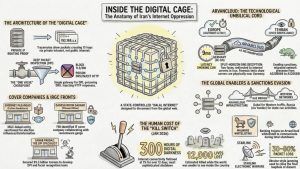

Iran’s 2026 uprising isn’t just happening in the streets anymore — it’s happening inside the regime’s own networks. And the Islamic Republic is losing hard.
In a major digital strike, anti-regime hackers reportedly hijacked Iran’s Badr satellite signal, cutting into state-controlled broadcasts and replacing regime propaganda with raw resistance messaging — including protest clips, solidarity footage from around the world, and a message attributed to exiled Crown Prince Reza Pahlavi.
This wasn’t just a hack. This was a psychological cyberweapon.
For roughly 10 minutes, the regime’s carefully curated media machine got flipped against itself — turning Iran’s own broadcast infrastructure into a megaphone for the revolution. The message was blunt: the government can censor the internet, but it can’t secure its own systems.
And the real impact?
It’s not the embarrassment — it’s the signal to every Iranian watching:
✅ They’re vulnerable.
✅ They’re penetrable.
✅ They’re losing control.
Even more explosive, the hacked content reportedly included calls aimed directly at the regime’s enforcement arms, urging security forces and military personnel to defect and side with the people — a strategic move that turns digital disruption into real-world pressure.
Iran’s leadership has spent decades building a surveillance state. But now, the revolution is pushing back with something the regime can’t arrest: code, access, and insurgent-level information warfare.
This is what a modern revolution looks like in 2026:
Street resistance + cyber sabotage + total narrative collapse.
And as the regime’s grip slips, one name is rising again — Pahlavi.
The return isn’t just possible… it’s what we want. 👑Pahlavi